
Why Options Get Expensive Before Earnings
How the options market quietly prepares for earnings surprises, and the number that reveals what traders expect.

Hey, before we get to today’s newsletter, here’s a quick update.
Our aim at Zerodha Varsity is to make financial education simple and accessible. Apart from writing these newsletters, we also conduct free bootcamps, workshops, and online sessions across topics such as stock markets, trading, macroeconomics, and personal finance.
If you haven’t explored them yet, you can check out our online sessions here and upcoming events here.
The market has never been short of surprises. Since 2020, we’ve seen a pandemic, wars, sharp turns in interest rates, and countless earnings announcements that sent individual stocks soaring or sinking overnight. Looking back, those moves seem obvious. What is easier to miss is that, before the news even arrived, the options market was already behaving differently. Not because anyone knew what would happen, but because it was reacting to uncertainty itself.

This brings us to the quiet period just before a company reports its quarterly earnings. In these final days, because the direction of the news is genuinely unknown, the share price has little reason to drift and often stays fairly still. Yet, beneath this calm surface, the options market is anything but quiet. Both the call, which pays off if the stock rises, and the put, which pays off if it falls, become more expensive at the same time. The market is quietly bracing for a large move without betting on its direction. The uncertainty missing from the share price has simply moved into the options.
Wipro’s pre-earnings price action shows this perfectly. Before its results, the stock usually stays within its recent range, giving away very little. But after the results are announced, every quarter looks different. Some announcements barely move the stock, while others send it dramatically higher or lower. The evening before gives no clue which kind of quarter this will be, which is precisely the mystery the options market tries to price.
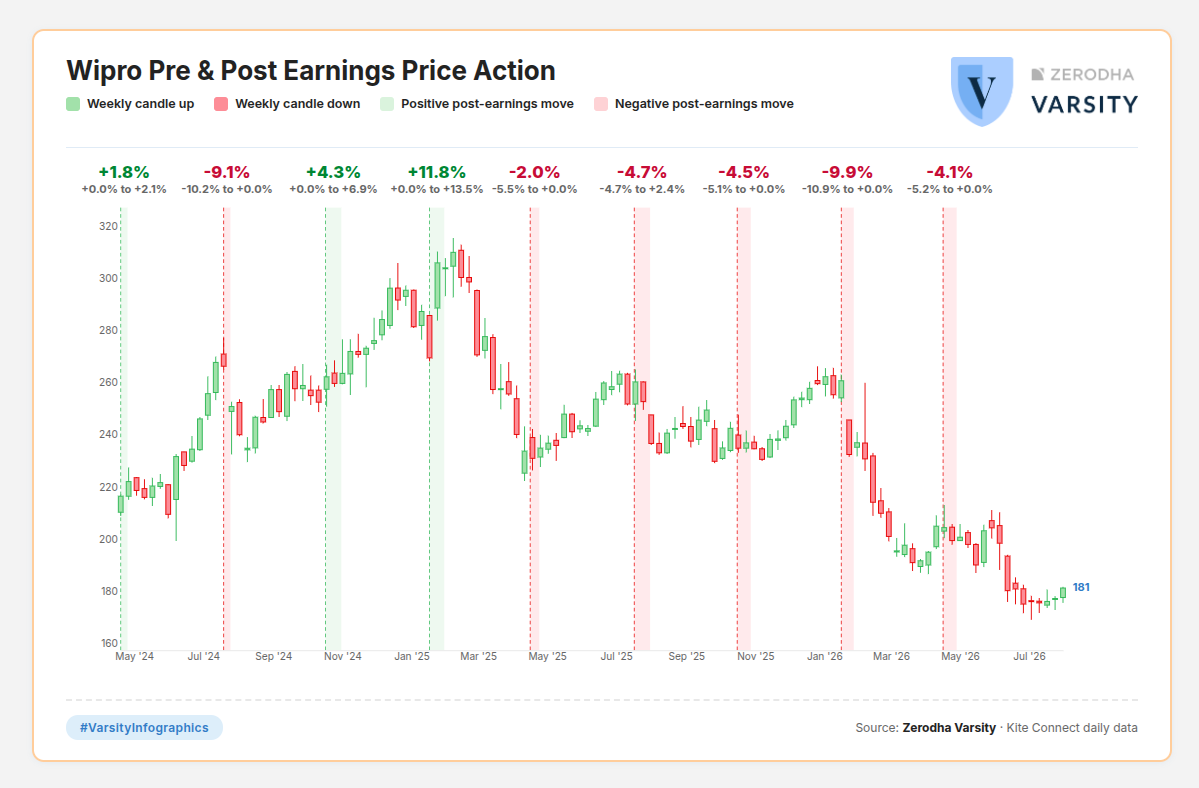
Expectation vs. Reality
Before we can understand what the options market was forecasting for Wipro, it helps to look at what had actually been happening. The year 2026 had been volatile, with wars, trade tariffs, and foreign investors pulling money out of Indian stocks all pushing prices around. This brings us to a key concept: realized volatility. It simply measures how much a stock has actually moved in the recent past.
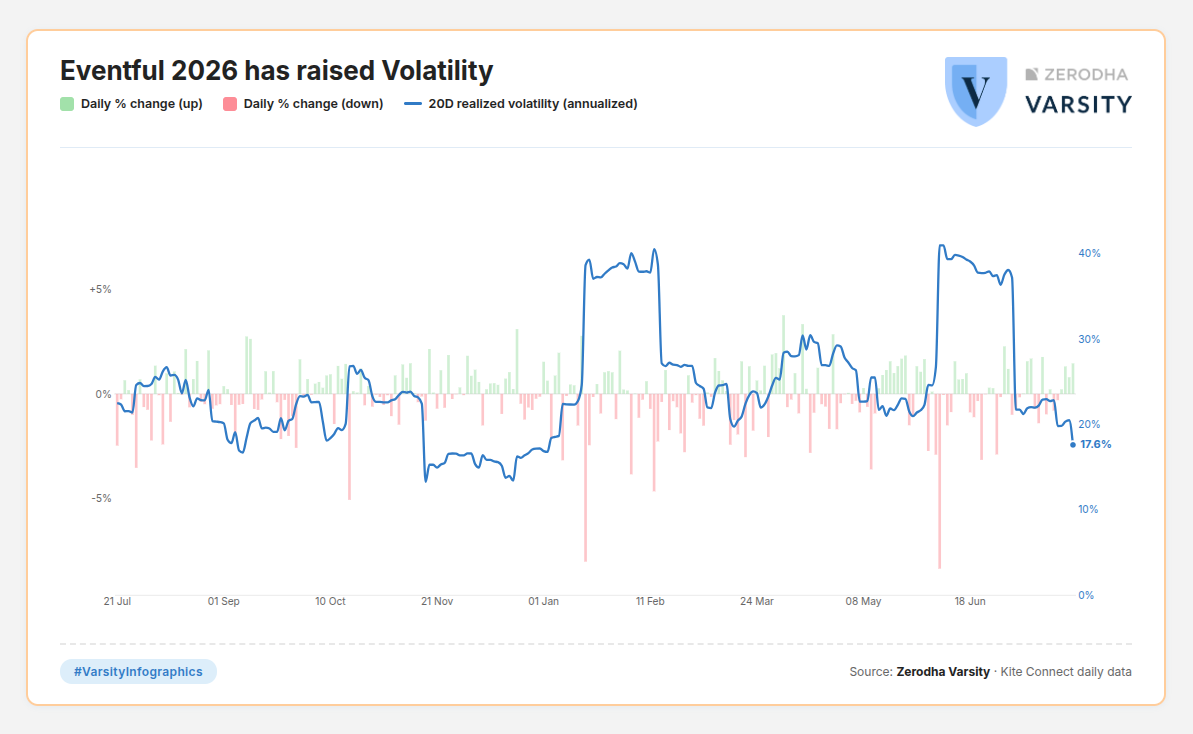
Wipro’s stock reflected this story. While it had periods of relative calm, its price swung twice pushing its realized volatility from around 20% to nearly 40%. If realized volatility is the story of movement that has already happened, implied volatility (IV) is the market’s expectation of future movement. It is the number at the heart of our pre-earnings mystery, reflecting how much of a price swing the options market is anticipating before a particular option expires.
Reading the Forecast
But a number like implied volatility means very little until you know what is normal. An IV of 40% could be unusually high for one stock but completely normal for another. This is why traders don’t just look at IV; they look at the Implied Volatility Percentile (IVP). IVP compares today’s IV with the stock’s own IV over the past year, giving it a score from 0 to 100. A reading of 90 means today’s IV is higher than it was on 90% of trading days over the last year, signaling that the market’s expectation for movement is unusually high.
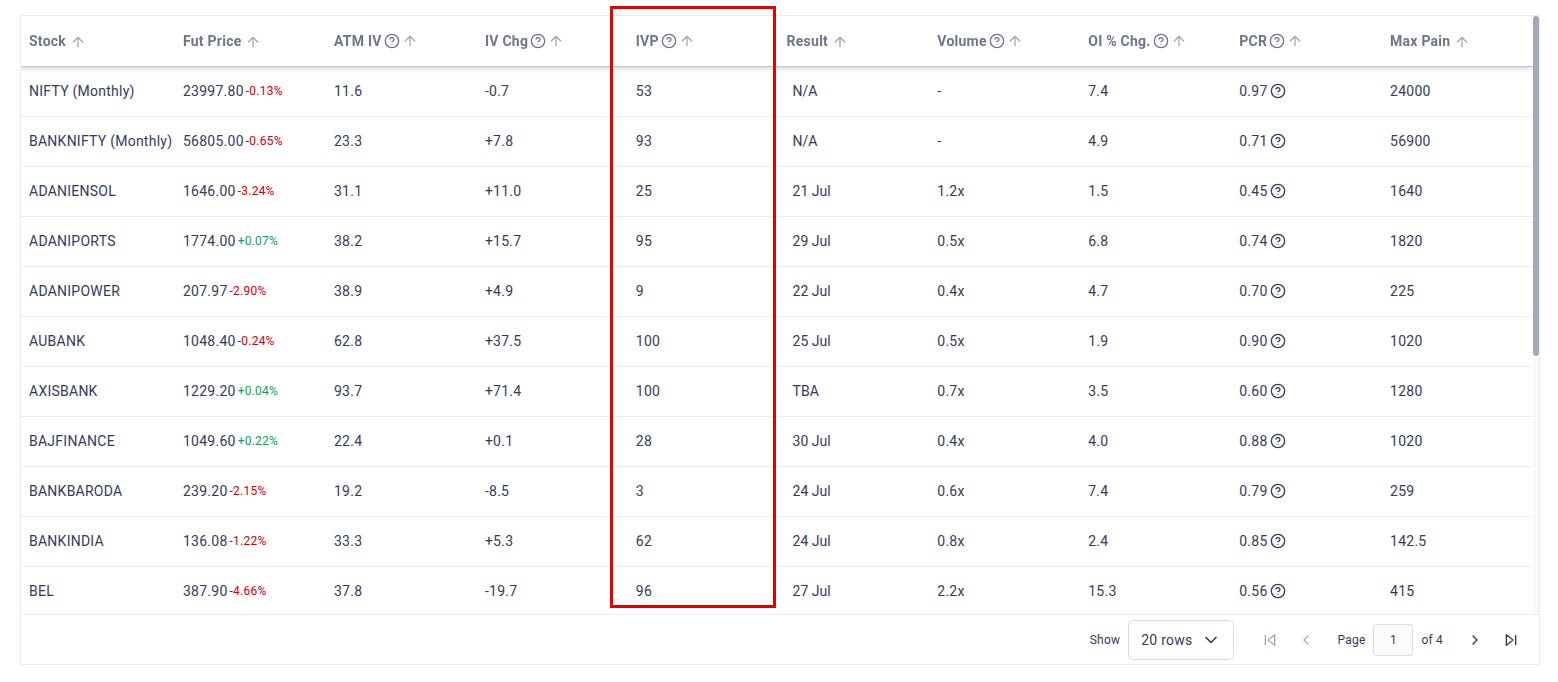
The difference between IV and IVP is critical. Consider Adani Power and Adani Ports. They have almost the same implied volatility, around 38-39%. But their IV Percentiles tell opposite stories. Adani Power’s IVP of 9 shows its current IV is among the lowest it has been all year. Meanwhile, Adani Ports has an IVP of 95, meaning its IV is near a yearly high. The market is pricing in far more uncertainty for Adani Ports, a context only IVP can reveal. Looking at the table, you’ll notice many stocks with the highest IVP are, unsurprisingly, just days away from their earnings announcements.
The Storm That Never Came
Now, let’s apply this lens to Wipro. In the run-up to its results, its implied volatility climbed to about 41%, pushing its IV Percentile to 95. The market was clearly expecting a much larger move than usual. This is the moment some traders wait for. They see a high IVP and believe the market has priced in too much uncertainty. Their strategy is to sell both the call and the put, collecting the high premiums while betting the actual stock move will be less dramatic than expected.
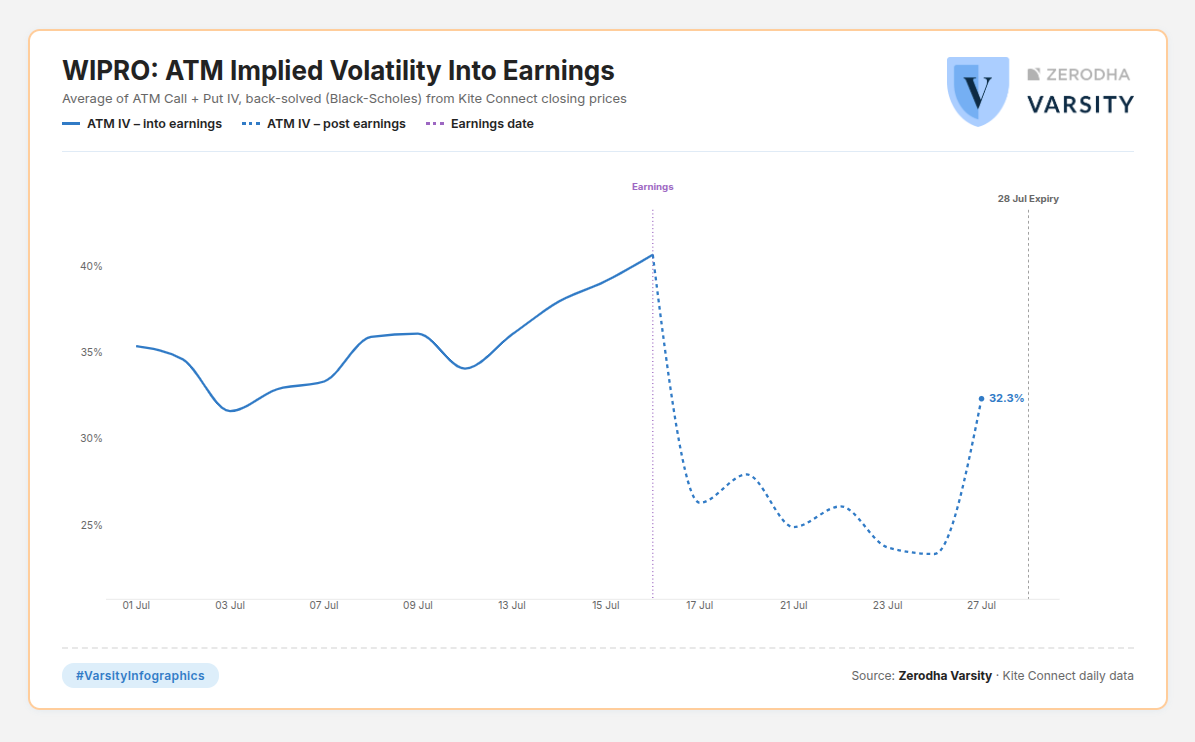
Notice what happened the moment Wipro announced its results. Implied volatility fell sharply, dropping from 41% to the mid-twenties in a single session. This is the IV crush. An option works a little like insurance: it costs more when a storm is in the forecast and less once the sky has cleared, because what you are really paying for is the uncertainty, not the storm itself. Once the result was out, that uncertainty was gone, and the inflated premiums went with it, whichever way the news broke.
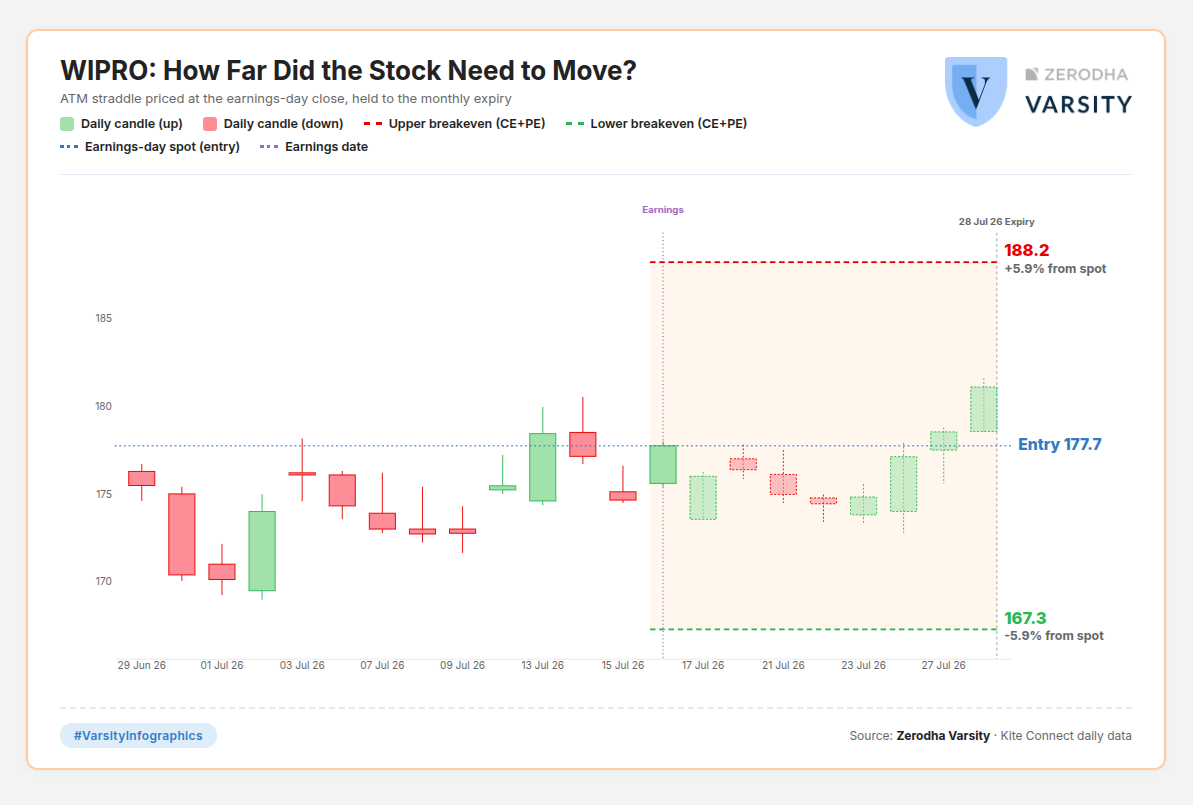
On the evening before its results, the options market had priced in an expected move of about 5.9%, creating a breakeven range for the seller of both the at-the-money call and put options between 167.3 and 188.2. As it turned out, Wipro rose only about 1.9%, finishing the month near 181. The stock stayed well within the range the options market had priced in. The trader who recognized that the market had priced in more fear than the event eventually delivered came out ahead, not by predicting the news, but by correctly judging the market’s overestimation of the move.
When the Storm Comes Anyway
But this strategy doesn’t always work. Wipro is only half the story. TCS, which reported its earnings earlier, shows what happens when the market’s expectations are too low. Before its results, the options market priced an expected move of about 6.2%. A trader selling those at-the-money call and put options together might have concluded, just as with Wipro, that the market was expecting too much.
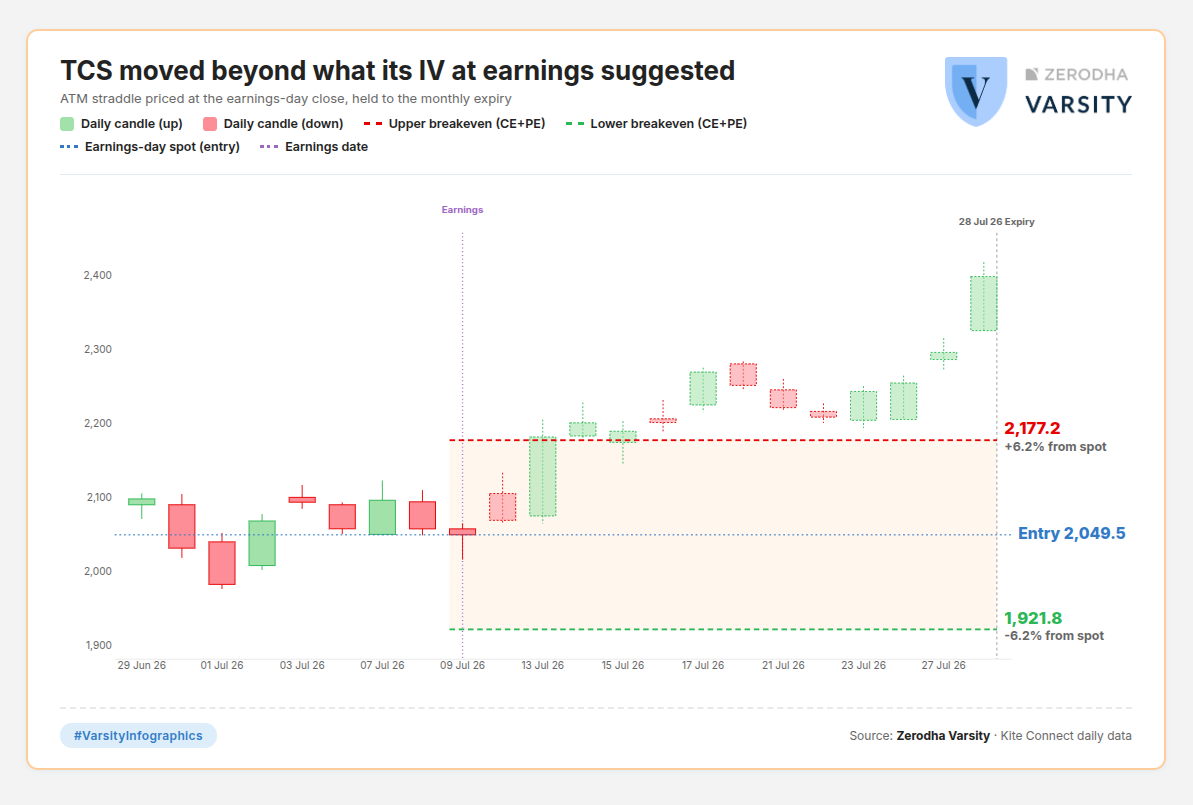
This time, they would have been wrong. Once TCS announced its results, the stock moved well beyond the 6.2% range, pushing past the breakeven levels and into a loss for the seller. That is the risk. A buyer of an option can only lose the premium paid, but a seller’s losses can keep growing if the stock moves much further than expected. The same approach that worked on Wipro failed on TCS.
The Closing Bell
The key lesson is this: implied volatility is a powerful tool for understanding how much movement the market is expecting, and IV Percentile tells you whether that expectation is unusually high or low for a particular stock. But neither is a prediction.
Before an earnings announcement, the options market prices uncertainty into both the call and the put. Once the results are out, that uncertainty vanishes, implied volatility falls, and option premiums fall with it. Traders are not trying to predict the news. They are trying to judge whether the market has priced in too much movement or too little. Implied volatility does not tell you what will happen. It tells you what the market expects to happen. Understanding that difference is the first step to understanding how options are priced.
For market education only, not investment advice.
This newsletter is written by Akshay Navin.
Do read, “Why does India target 4% inflation? And not 0%?” in our Tell My Why newsletter.
For any feedback or topic suggestions, write to us at varsity@zerodha.com

Good theoretical exercise! May not be the only factor for Options price movements. Take for example Waaree Energies, the last 10 trading sessions - both cash and F&O prices have dropped sharply. That is definitely not just technical correction.
Good analysis. IV based trading strategy around earnings announcement works well. but it ain't for the ordinary trader.