

In 1987, the Nobel Prize-winning economist Robert Solow wrote:
“You can see the computer age everywhere but in the productivity statistics.”
Computers were on every desk. Offices were buying them by the truckload. And yet, when economists looked at the numbers, output per worker in America was barely budging.
It was the Solow Paradox.
Here is one chart that captures this, from the post-World War II period to when Solow made that remark. It compares the trend in labour productivity growth to the overall capital share of IT equipment and intellectual property products (IPP).
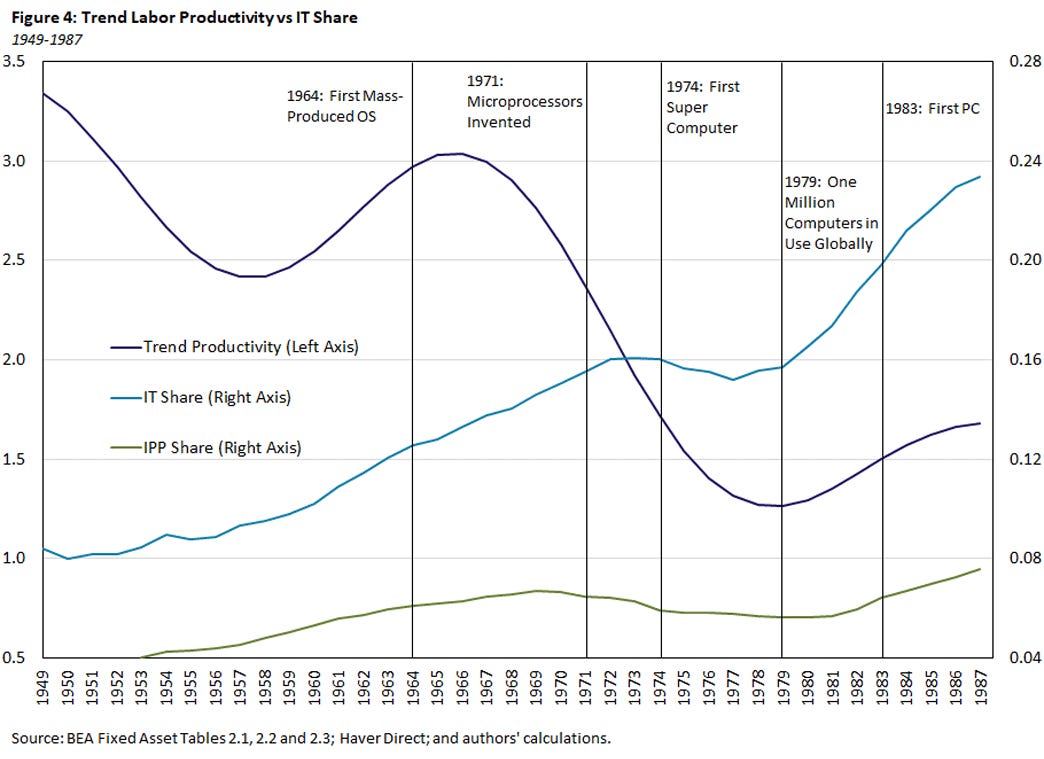
As you can see, trend growth in labour productivity slowed dramatically, from 3.8% in 1948 to 1.2% in 1987. To be clear, productivity didn’t decline. It just didn’t rise the way people expected it to.
Now, I want to be clear about one thing here. When economists say productivity, they usually mean labour productivity: how much output the economy produces for every hour people work. What they usually track is how fast that number grows from one year to the next.
For example, say a bakery in Bengaluru has 5 bakers working 8 hours a day. Together they bake 400 loaves of bread. That’s 400 loaves ÷ 40 hours = 10 loaves of bread an hour.
Then the bakery buys a better oven. The same 5 bakers, the same 40 hours, now bake 480 loaves. That’s 12 loaves an hour.
Productivity has gone up by 20%.
And that is the whole game. Because productivity is the only way a country gets richer without simply working longer hours. More output per hour means the bakery can pay its bakers more, cut prices, or do both. Scale that up across millions of businesses and you get rising living standards.
That’s why economists get so excited about any new technology. The steam engine, electricity, computers, the internet. Each was supposed to make every hour of work produce more.
And AI is being sold as the biggest of them all today.
That’s also exactly why I started this edition of Tell Me Why with the Solow quote. Because nearly 40 years later, swap “computer” for “AI” and you have the same questions being raised about productivity.
Here’s a recent chart from asset management firm Apollo. It measures something called Total Factor Productivity (TFP), the green line. Think of TFP as output adjusted for extra working hours and extra money spent on new machines. So if companies can produce more without adding more inputs, TFP rises.
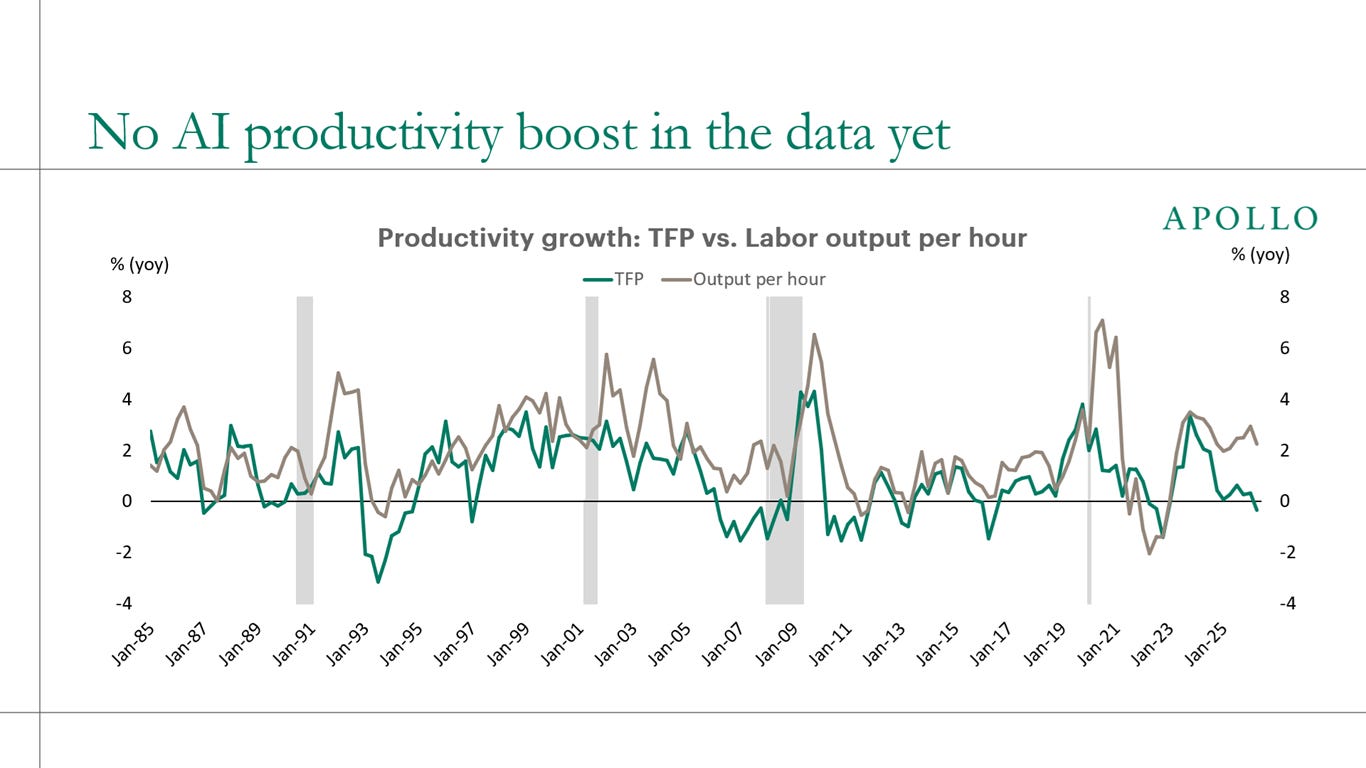
As Apollo’s Chief Economist Torsten Slok wrote, “It [TFP] is the closest available proxy for technological progress and for genuine improvements in how inputs are combined.” And so far, that green line shows nothing like an AI-sized jump.
So here’s the question.
If companies are spending hundreds of billions on AI (Microsoft alone is spending ~$150 billion on AI infrastructure and laying off workers), and AI companies are earning billions from it (Anthropic’s revenue grew to $16.3 billion in the first half of 2026, up from $1.2 billion a year earlier), why aren’t we seeing the oven moment in the productivity data?
Well, let’s rewind a bit, to long before Solow’s time. Because there’s an old story economists love to tell: about electricity.
Thomas Edison opened his first power station in New York in 1882. Electric motors were clearly better than steam engines. And yet, for nearly four decades, American factory productivity didn’t really take off.
Why?
The economic historian Paul David tried to answer this in a 1990 paper titled The Dynamo and the Computer.
His answer was that factories didn’t know how to use electricity yet.
See, a steam-powered factory was built around one giant engine. It turned a long shaft running across the ceiling, and every machine on the floor was connected to that shaft by leather belts. Factories were multi-storey and cramped because the machines had to sit close to the shaft.
When factories first switched to electricity, many of them did the obvious thing. They ripped out the steam engine and put in one big electric motor. Same shaft. Same belts. Same building.
And so, the same productivity.
The real gains came only when factories were redesigned from scratch. Each machine got its own small motor. Buildings became single-storey and spread out. Work could flow in a line, the way the product was actually made. That took a new generation of factories, managers, and engineers.
It wasn’t until the 1920s that US manufacturing productivity surged as this paper highlights:
The rise in manufacturing factor productivity in the 1920s was an unprecedented 5.3 percent per year, more than four times agriculture’s 1.2 percent.
The technology arrived in the 1880s. The productivity arrived decades later.
And it’s not just electricity. Take computers too. In a speech given to the American Economic Association in 2004, the then Vice Chair of the Fed pointed this out:
Since 1995, labor productivity has risen at an average annual rate of about 3 percent, up from an average annual rate of around 1-1/2 percent between 1973 and 1995. And in the past two years alone, output per hour has increased more than 5 percent per year.
Now, apply this to AI.
Today, most companies are doing the “one big motor” thing. They’ve dropped a chatbot into the same old workflows. But there’s the same approval chains, the same meetings, the same organisation charts.
A report that took 3 hours now takes 1 hour, but it still waits 3 days for a manager to sign off.
The gains come when the whole process is rebuilt around the new tool. And that’s expensive and slow.
In 2021, economists Erik Brynjolfsson, Daniel Rock, and Chad Syverson gave this pattern a name: the Productivity J-Curve (pdf).
Their argument goes like this. To use a general-purpose technology (not the kind of GPT you’re thinking of) well, companies first have to invest heavily in things you can’t see on a balance sheet. Retraining people. Redesigning processes. Cleaning up years of messy data. Economists call these intangible investments.
But there’s a catch.
When employees spend their time on these things, they’re not producing output that GDP counts. So measured productivity actually dips in the early years.
Later, once those intangibles start paying off, output rises without much extra measured input. And productivity looks like it suddenly shot up.
Draw that on a chart and you get a J. A dip first, then a climb.
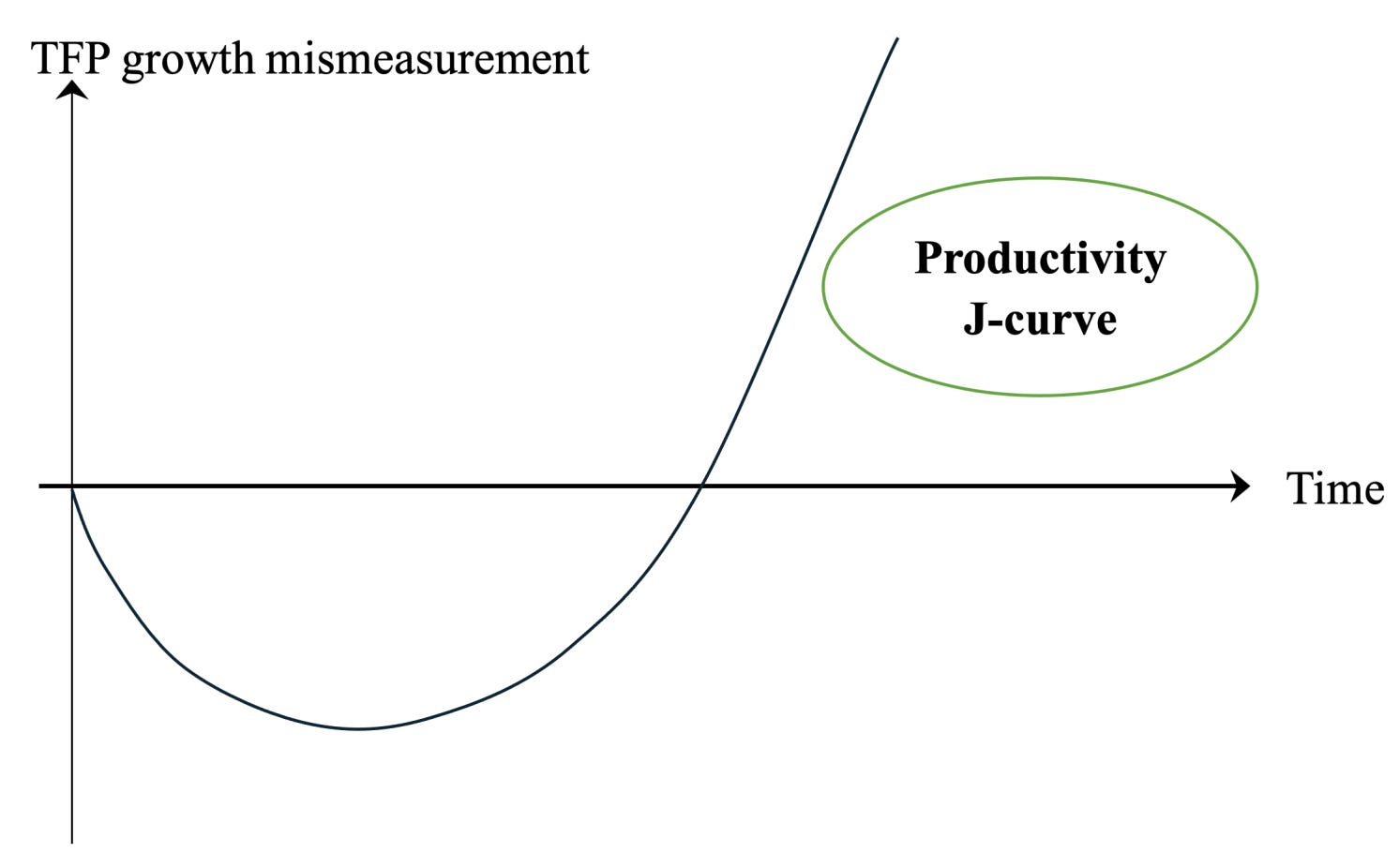
If they’re right, the absence of an AI boom today isn’t evidence that AI doesn’t work. It might be evidence that we’re still at the bottom of the J.
Of course, the J-curve is a hypothesis, not a promise. Not every technology gets its upswing. And even if AI does, how high the J climbs depends on who you ask, and on their assumptions.
Nobel-prize winning economist Daron Acemoglu tried to answer this in a 2024 paper called The Simple Macroeconomics of AI. And he uses simple arithmetic to figure out the broader, economy wide impact:
Share of tasks AI affects × How much cost it saves on those tasks
That’s it in a nutshell.
And his estimate for the total boost to productivity was well under 1% over 10 years. Not per year. In total.
Bear in mind, though, that Acemoglu assumes only about 5% of all tasks in the US economy could be profitably handed to AI over the next decade.
There’s also a reason why micro-level magic gets diluted at the economy level. Economies don’t produce goods through single actions. They produce them through millions of discrete tasks that depend on each other.
Think of a hospital. AI can now draft discharge summaries, code insurance claims, and read scans faster. Wonderful. But the patient still waits for the one surgeon who can operate, and the nurse who changes the dressing.
Even if AI creates massive efficiency gains in the specific tasks it touches, its aggregate effect is diluted by the sheer volume of tasks it doesn’t touch.
Of course, Acemoglu leans towards the pessimistic side.
We have optimists too, such as Goldman Sachs, which estimates AI could lift US labour productivity growth by about 1.5 percentage points a year over a decade, once adoption is widespread. Part of the gap is that the bank expects about 25% of tasks to eventually be automated, compared with Acemoglu’s 5%. It also counts the wider benefits from workers moving into new roles and AI creating entirely new kinds of work.
As to which side will be right, only time will tell.
But it’s worth remembering how Solow’s paradox ended. He made his remark in 1987. Computers finally showed up in the productivity statistics in the late 1990s, roughly a decade later.
So if you can see AI everywhere but in the productivity statistics today, hold on. It might just mean it’s following the footsteps of electricity and computers. A little late to show up.
This newsletter is written by Nithin Sasikumar
Do read our Second Order newsletter.
For any feedback or topic suggestions, write to us at varsity@zerodha.com

Just finished reading the solow model, and saw this amazing real life case study!
The oven moment shows in the grey output-per-hour line because TFP takes out the money spent on the oven. Slok's note puts output-per-hour growth near 2.5% and reads that as more or better equipment rather than a technology-driven jump.