
When Microsoft Swapped CDs for Subscriptions
One decision, multiple outcomes: killing a three-year software cycle, tackling piracy, and creating a cash-printing annuity.

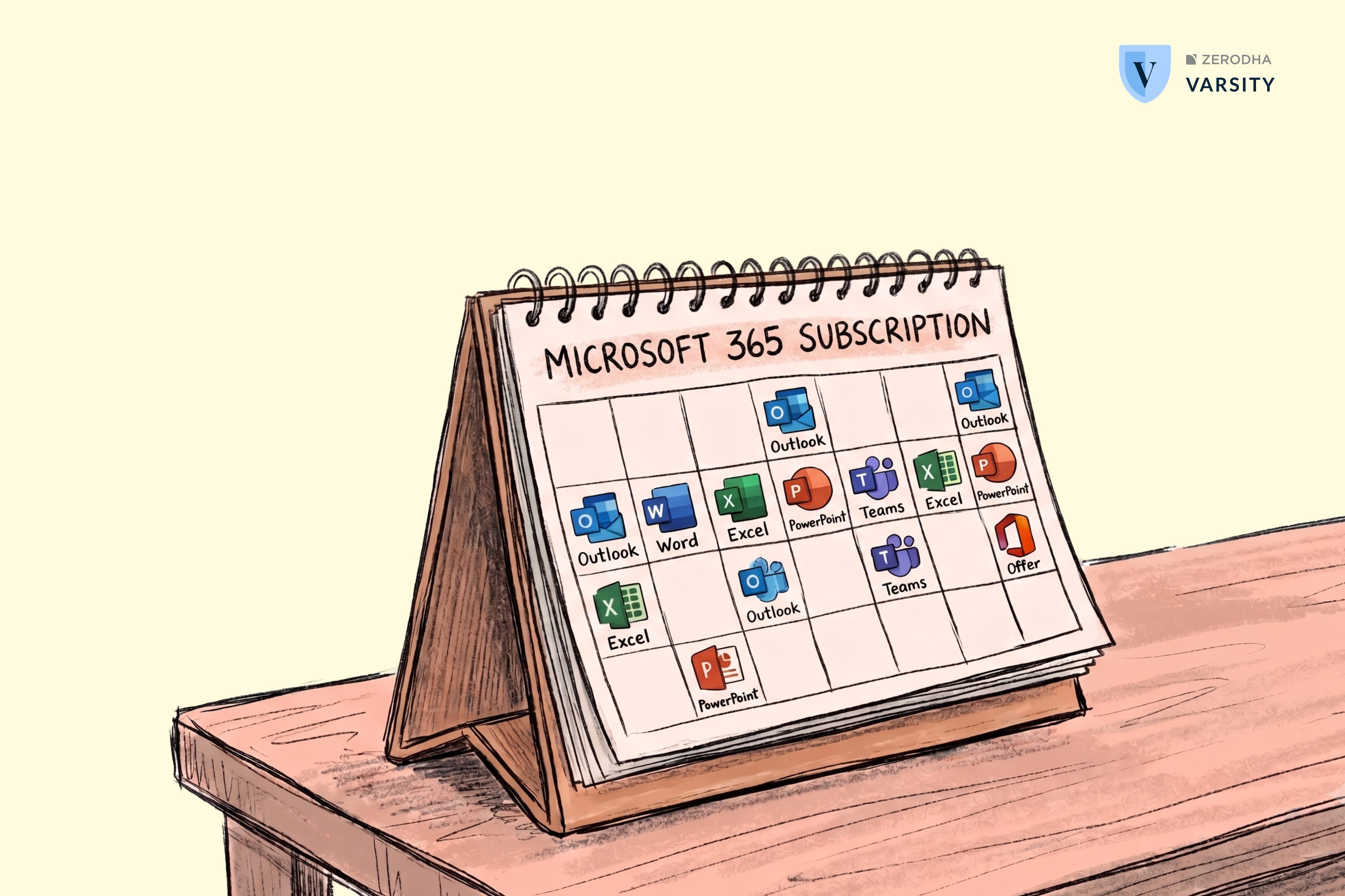
When you buy a computer or a laptop, in all likelihood, you will also buy a Microsoft Office pack with it. That Office pack lets you use Microsoft Word, Excel, or PowerPoint. Earlier, it was a one-time purchase. You could use it for years. But now you also have the pay-per-year model, or a subscription model. And Microsoft, in fact, wants you to buy this subscription version.
In this newsletter, we’ll try and understand Microsoft’s motivation behind switching its pricing from a one-time purchase to a subscription model.
Microsoft launched its first-ever Office Suite with Word, Excel, and PowerPoint back in 1989-1990. You would buy the suite once, often as a box of CDs or a one-time download, and use it for years. Microsoft would launch new versions every three years or so. But as a customer, you could continue using the older versions. This went on for nearly two decades before a dramatic change.
In 2013, Microsoft introduced Office 365, a subscription-based version of Office. Essentially, it was steering away from selling a static product and reinventing it “as a consumer cloud service”. Instead of paying, say, Rs 10,000 upfront for Office 2024 and keeping that same version indefinitely, customers could now pay about Rs 7000 per year for Office 365. It would give access to all that the static version would offer, but on five devices, plus extras like online storage and continuous new feature upgrades.
Office 365 blew up that three-year cycle. The subscription model let Office evolve continuously rather than in big jumps every few years. This ensured users always have the latest features without having to manually purchase an upgrade or reinstall software.
It was also a response to the changing times. The early 2010s saw the rise of cloud computing and software-as-a-service. Companies like Google were offering Google Docs and other Office apps essentially for free. Other rivals were moving to more agile development cycles.
Microsoft never publicly admitted that Google triggered a switch in its business model. But it was only natural for Microsoft to introduce a similar subscription version like Google. Microsoft’s move was partly defensive – to ensure Office remained relevant in a cloud-connected world – and partly an offensive play to leverage its huge user base into a cloud service.
The pivot to subscriptions was also driven by solid business reasoning. Instead of seeing a spike in sales whenever a new Office version launched and then a lull as sales tailed off, a subscription model would generate recurring income every month or year. Investors and executives love predictable revenue — it’s easier to forecast and companies with high subscription revenues also enjoy higher valuations.
Beyond the recurring revenue, customer lifetime value tends to increase under subscriptions. Subscriptions increase stickiness. Moreover, if a customer is accustomed to using Microsoft’s Office suite, they might find it difficult to switch to Office substitutes, such as those offered by Google and others. So, they might just continue to pay for Microsoft Office.
Microsoft clearly recognized this “annuity” value. Such a model also changes the relationship with the customer — instead of a one-and-done transaction, Microsoft can now have an ongoing engagement with Office 365 users, giving it more opportunities to upsell new features.
Stickiness is even higher among business customers. Businesses find it extremely challenging to switch their existing Office suite. It involves several weeks, if not months, of communication, training, handholding, and follow-up to get all employees comfortable with a new Office Suite. And while such a switch happens, the operations could slow down, employee responsiveness might get delayed, and productivity hampered. So, if a business buys Microsoft’s Office suite, most likely it will stick with Microsoft for a very long time.
This is also a drawback, though. If a customer is already using, say, Google Workspace, it becomes that much more difficult to convince them to switch to Microsoft.
And customer stickiness or not, such a switch in pricing is often seen as a gamble. Existing customers may have felt that Microsoft had found a way to milk their pockets.
But Microsoft had not abandoned its one-time-purchase offering. If you want, you can still make that one-time purchase and not pay annual subscriptions. However, you might feel a differential treatment being meted out to you because you did not choose to subscribe. Indeed, Microsoft heavily promotes the subscription versions.
So did the bet pay off?
Early signs indicated yes. Within just over three months of its debut, Office 365 Home Premium hit over one million subscribers. For comparison, that adoption outpaced some other big subscription launches; it took Adobe about seven months to reach a million subscribers after it shifted Photoshop and its creative suite to the cloud. Microsoft even touted that the 2013 release of Office was the “best-selling Office edition yet,” with more than one copy being sold every second at one point.
Microsoft’s stock price, which had remained practically flat for almost 12 years after the dot-com bubble, actually started rallying 2013 onwards.
Basically, the market was validating Microsoft’s new strategy. Fast forward to today, and subscriptions have clearly become the norm for Office. It has been renamed to Microsoft 365, signalling a broader, cloud-focused offering beyond just the core Office apps.
As of 2024, Microsoft 365 had over 400 million users. That massive subscriber base translates into a huge, reliable revenue stream.
You know one serious benefit of a subscription model?
The scope of piracy is low.
Software piracy was a major issue. Microsoft Office was widely pirated. Even Adobe estimated over 40% piracy rates for its perpetually licensed software in some markets. A subscription tied to cloud services and frequent updates can mitigate piracy. It is harder to pirate something that requires online account checks and is constantly changing. It also ensures more users are on the latest version rather than a mishmash of old versions. This uniformity can lower support costs and security risks since fewer customers are stuck on outdated, unsupported software.
As far as customers are concerned, the subscription model is better suited in two ways.
One, they get new updates as and when they are released,
And two, they can use Microsoft Office on multiple devices
However, costs might be a bit too high for them. Of course, the upfront cost goes down, but the customer has to bear a recurring cost every year. And it might even grow with inflation.
Then there is subscription fatigue. How many subscriptions can one really handle?
Gym subscriptions, Netflix, insurance premiums, Cloud storage, even meal kits. And of course, Microsoft Office. All those recurring charges add up, and consume a substantial portion of one’s income. The psychological effect of too many subscriptions can turn people off, and a product that might have been fine as a one-time purchase could lose customers if they don’t want yet another ongoing bill.
Microsoft, however, did not lose customers.
In fact, Microsoft’s shift with Office is part of a much broader trend in the software industry. Many software companies that once sold boxed software have pivoted to subscriptions to stay competitive and meet investor expectations. One of the most cited examples is Adobe, the maker of Photoshop and other creative tools.
Companies like Oracle and SAP that traditionally sold expensive on-premise licenses are now pushing cloud subscription versions of their software. Even smaller software startups today almost all start with a Software-as-a-Service subscription model by default – it’s just how software is commonly delivered now.
Of course, it is not cast in stone. Businesses have designed different pricing models now.
Some businesses highlight their one-time purchase model as a selling point to differentiate from subscription-heavy competitors.
Some others offer both models: a subscription for those who prefer smaller payments and constant updates, and a one-time purchase of a perpetual license for those who want full ownership. Microsoft is a case in point.
Then there are hybrid approaches: some software subscriptions allow you to keep using the last version you downloaded, even if you stop your subscription.
These nuances show that businesses are experimenting to find the sweet spot that customers accept.
Interestingly, moving to a subscription model is far more common than moving back to one-time sales, but there are examples of the latter in a roundabout way. In the gaming industry, for instance, many online games used to require monthly subscriptions to play, like the famous World of Warcraft. Over time, many of those shifted to free-to-play or one-time purchase models with optional microtransactions, because players showed resistance to too many subscriptions.
So, while the tide is toward subscriptions, savvy companies have listened to their users and sometimes course-corrected if a pure-subscription strategy wasn’t feasible for their customers.
Do read “Tax the Rich. Simple, Right?” in our newsletter, Tell Me Why by Zerodha Varsity.
For any feedback or topic suggestions, write to us at varsity@zerodha.com.
Zerodha Varsity is now on WhatsApp. Follow on to keep track of all things Varsity across platforms.
You missed out the latest rugpull by Microsoft where it's planning to remove access for people using one-time purchased Office apps.
Advantage for Customers
Lower Upfront Cost - Instead of paying ₹50,000 for software, users might pay ₹500/month.
Continuous Updates - Software and services can improve continuously without requiring new purchases.
Flexibility - Users can often cancel when they no longer need the service.
Disadvantage For customers:
Many subscriptions can quietly accumulate and become expensive.
You may end up paying forever for something you once could have owned outright.