

Politicians are obsessed with “freebies” in India.
One party announces cash transfers to women. The other party promises loan waivers to farmers. Someone adds free electricity. Another throws in free bus rides. Even free mobile internet data packs are on the table. The financial promises add up quickly.
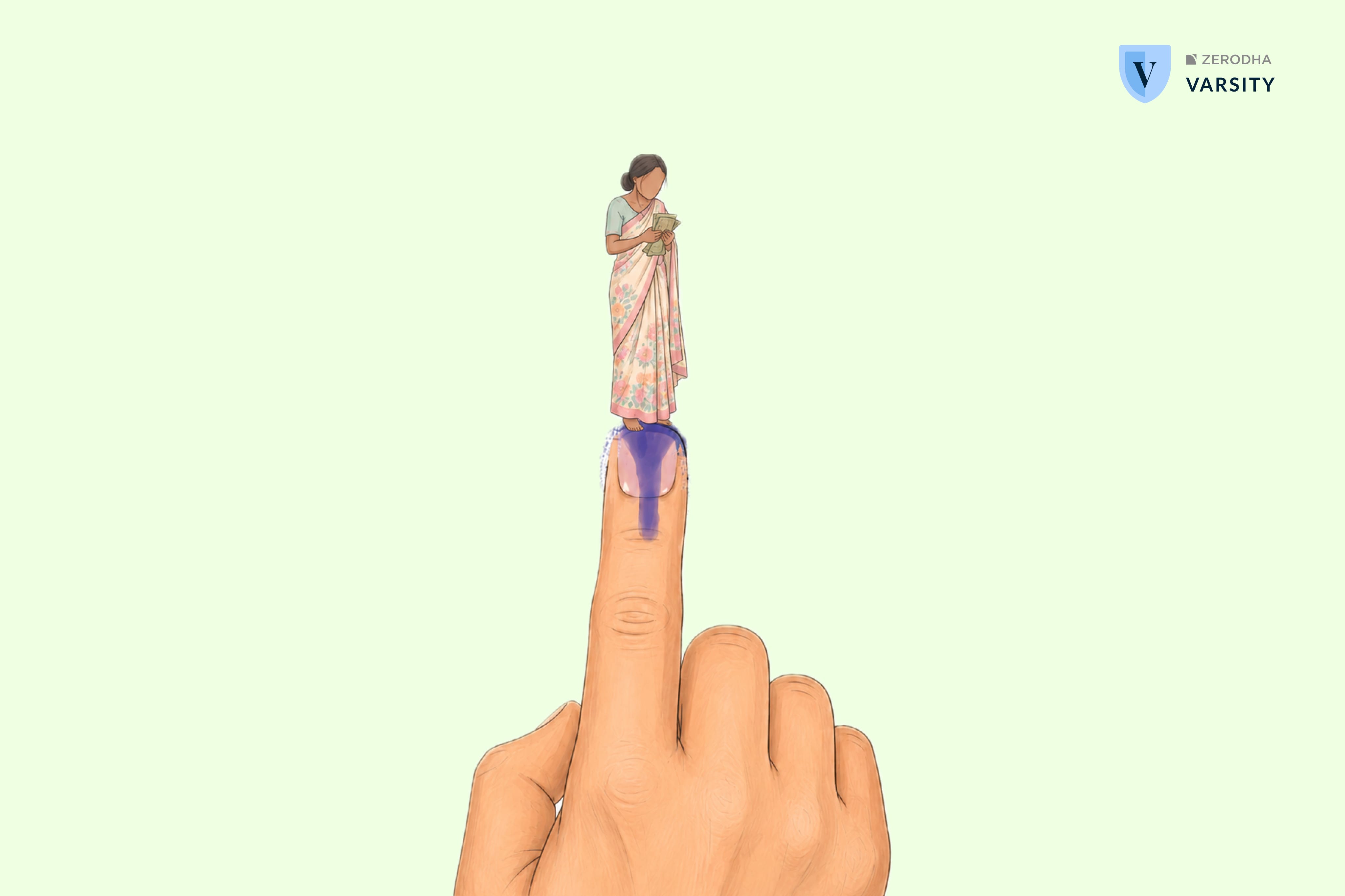
And while these keep a section of India happy, the ~3% of income tax paying Indians are becoming increasingly disgruntled. After all, the state’s generosity is nothing but taxpayer money.
I’m not going to get into the politics of freebies now. We know the why (votes) and the who (all parties). What I want to talk about is the economics of these freebies — the good, the bad, and the ugly.
And strap in because it’s going to be a long one.
What is a freebie, anyway?
We first need to try and define what exactly these freebies are. Because that debate itself tells us whether they’re something to be lauded or vilified.
So,the Reserve Bank of India (RBI) says it’s “a public welfare measure that is provided free of charge.”
Technically that means any programme that is designed to improve the quality of life of the people is a freebie — including cash transfers or subsidies for agriculture.
That does seem harsh considering that the term freebie is pretty much used as a pejorative these days.
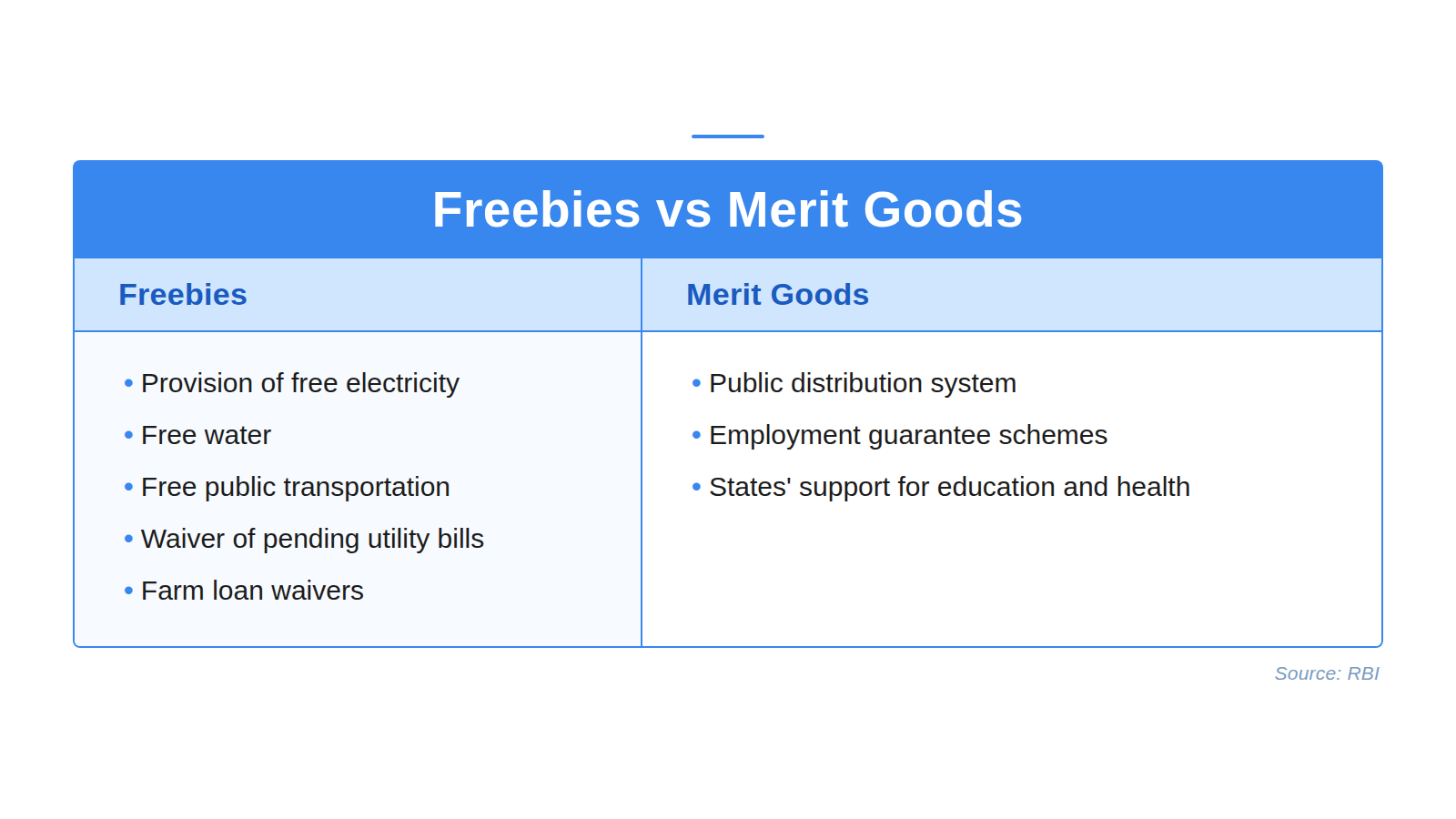
But then, it goes on to say that we can make a distinction between general freebies and merit goods that may also be provided for free. And it gives examples — free water is a freebie but health support is a merit good.
The concept of merit goods was introduced by the German-American economist Richard Musgrave in 1957. And the crude idea behind it was goods that have a positive ripple effect on society, even if consumed by a limited number of people, can be considered a merit good.
Think of merit goods as long-term investments which improve the “human capital” of the country. For instance, an educated person contributes more to the GDP throughout their lifetime and also is said to have better civic responsibility towards society. At least in theory.
And if that happens, it creates a positive externality that doesn’t help just the person consuming the good but helps people around as well.
Freebies, on the other hand, are typically focused on consumption without necessarily boosting the economy’s future productive capacity. Like free televisions. Or free water, as the RBI says.
Now here’s where it gets interesting. Because I could debate that free water isn’t a freebie. Especially since the right to clean water is constitutionally mandated. And maybe we can make a distinction here.
Because the provision of basic clean drinking water can be a merit good.
Think about it.
It prevents water-borne diseases (cholera, typhoid), which reduces the public health burden and keeps the workforce productive. So there’s a positive externality associated with clean water.
So it’s a merit good, right?
It shouldn’t be patronisingly called a freebie.
However, if the government provides unlimited or high-volume free water for all, including high-income households, you could shift the label and categorise it as a freebie. I mean, people could use it to wash cars, water lawns, run their swimming pools…you get it.
It’s the same with electricity.
If access to free electricity means that it improves learning outcomes for children in a household — since it aids longer studying hours and even the use of electronics for learning, then it is a merit good. But free electricity for all could lead to overconsumption for non-utility purposes and put a strain on the grid.
In short, you can’t simply label everything a freebie. There’s a fine line. And as one Supreme Court bench said,
“The concern right now is what is the right way of spending public money. Some people say money is wasted, some say it is welfare. The issues are getting increasingly complicated.”
So those nuances are important for us to think about.
The Furore over Cash
So, what about cash transfers?
Because this seems to be another big sore point.
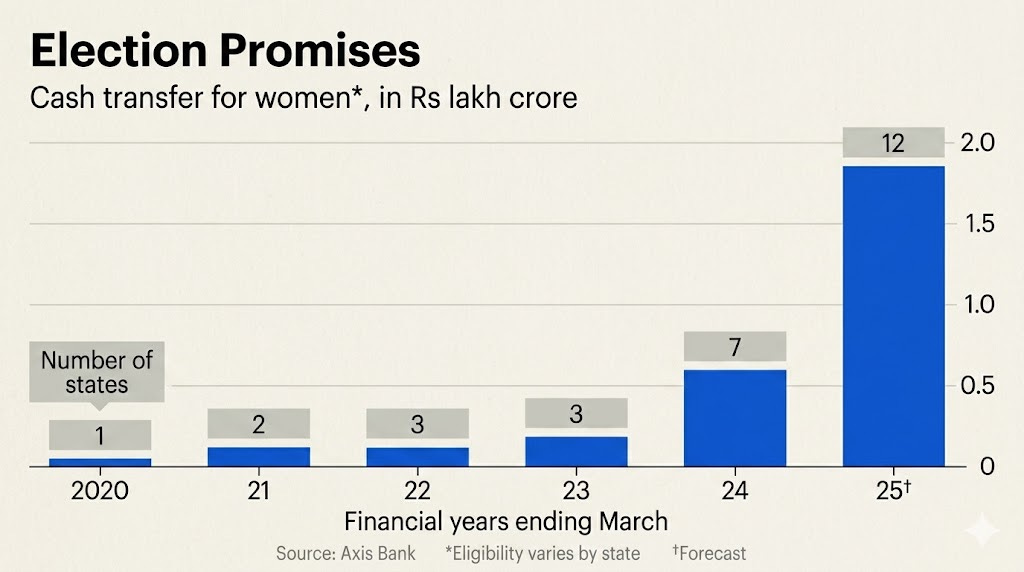
See, as per Axis Bank (pdf), just the unconditional cash transfers (UCTs) to women alone could total to a mammoth ₹1.7 lakh crore!
A UCT is when you receive the cash with no strings attached — you don’t have to prove you are looking for work, ensure your children are in school, buy specific fertilizers etc, which are common requirements in Conditional Cash Transfers (CCTs).
And this chart shows you how the UCT amount has ballooned in just the past 5 years to nearly ₹2 lakh crore annually. And the number of states and union territories doing it is upwards of 15 now. Goa launched a scheme in 2013. Assam got into the act in 2020. And since then, the party has not stopped.
But are UCTs “freebies”?
Well, in a traditional economic sense, UCTs don’t guarantee a specific “merit” outcome. The government isn’t ensuring a service is consumed and it’s just handing over purchasing power. The cash could be spent on anything, including demerit goods, such as alcohol and tobacco. And there’s no positive externality for society. In that case, it’s just a fiscal deadweight. Or a freebie.
But is it really?
Well, this is where it gets interesting because diving into UCTs as a focal point allows us to get into the good, bad, and ugly of freebies too.
So, I could make the argument that UCTs aren’t inherently a freebie and that it has merit. And I’ll explain that with a story from Kenya.
In 2014, the non-profit began a three-year experiment in rural Kenya to determine if no-strings attached cash would help the poor. Or whether the poor would be susceptible to squandering that money away on useless things. After all, there was no explicit instruction saying “you must spend it on food” or “you can’t buy alcohol with this.” Just money, deposited directly.
Naturally, the sceptics didn’t believe the experiment would bring any surprises. They believed the money would be wasted. And that people would even stop working because of the free money they had. They would drop out of the labour force.
And then the data arrived.
On the health front, infant mortality fell by 48% and children were about 44% less likely to go to bed hungry in households that received cash. On the economic front, households invested in businesses. Savings went up. And people actually worked more, not less. They used the cash as a stepping stone.
And that evidence contradicted most standard economic models. Why?
Nobel Economics Prize winner Abhijit Banerjee and Esther Duflo answered that in the Wall Street Journal
The logic of standard economics is that if you are richer, you would want to consume more of everything you enjoy, including leisure. But being richer also opens up economic opportunities. You could use your extra money to buy a machine that makes you more productive and therefore encourages longer hours, or some fertilizer that takes time and effort to put in the ground.
Also, you know how people say when governments undertake capital expenditure and build roads, bridges etc, that there’s a multiplier effect of the money? That it creates jobs, those people spend and all of that?
Well, that multiplier or the apparent lack of it is often touted as an argument against non-capex expenses such as freebies.
But in the results from Kenya, the findings were quite interesting. The multiplier effect did exist. Overall, the folks who received cash spent a lot of it. And that created more business for local shops. Which meant even the households who didn’t receive the cash benefitted. And they spent the additional money they earned too.
That’s quite a virtuous multiplier.
And Kenya isn’t a one-off. Across multiple low and middle income countries UCTs have shown remarkably consistent results. People don’t blow it all away. They invest in their kids’ education, in small businesses, in healthcare. When you give poor families autonomy over their spending, they tend to make better decisions about their lives than bureaucrats sitting in capital cities do.
Even in India. While Soutik Biswas at the BBC called India “the site of one of the world’s largest and least-studied social-policy experiments”, at least one study from Tamil Nadu gives us a peak into the impact of UCTs.
The women covered under the scheme recognised the ₹1,000 a month they were being paid was compensating their “unpaid domestic labour”. And that the money afforded them a dignity of financial independence. That feeling alone was enough to push them to do more. Overall, 89% of beneficiaries perceived that the KMUT ( Kalaignar Magalir Urimai Thittam/Kalaignar Women’s Rights Grant Scheme) scheme had enabled them to take up paid work, and 86% reported increased access to such opportunities.
Isn’t that a win for women’s labour force participation?
Of course we need more such post-experiment research to understand the true impact of these “freebies”. 1 in 5 women in India receive UCTs today and it’s time we spent more time understanding the ripple effects of such schemes.
Until then, I’d wager that even you’d consider UCTs to be a merit good now and not a “freebie”. Or at least even if not as a classic merit good, but one that achieves merit good outcomes — better health, education, and employment opportunities.
The Bad + The Ugly
But now that we’ve framed our thinking around freebies, we need to talk about a not so tiny problem cropping up in India — the finances of India’s states and the impact of freebies. This calls for a separate newsletter in itself so I’ll keep it brief for now.
See, the simple point is that we don’t have unlimited money. Whether at the Central level or State level. It’s always a trade-off between revenue expenditure (what freebies fall under) and capital expenditure.
And capex is where most economists would advise the government to spend the bulk of the money. Because every rupee of that capex — roads, railways, ports, digital infrastructure — does create a fiscal multiplier. By some estimates 2.5x of a multiplier. And that’s because it builds infrastructure that lowers costs, improves connectivity, and even has health benefits.
Today, we spend over ₹11 lakh crore every year now on capex. That’s just the central government. And when you add the state government capex to it, the number doubles.
On the other hand, as per analysis by the non-profit Project DEEP, we spend over ₹25 lakh crore on social services. That’s the welfare component of the revenue expenditure. The overall revenue expenditure is higher, of course.
And within this, nearly ₹2.8 lakh crores is just on UCTs.
Now hold on…you might have noticed that at the start of this newsletter I mentioned ₹2 lakh crores as the sum being spent on UCTs. But this number is significantly higher.
Well, the simple reason for that is the ₹2.8 lakh crore number is across the central and state governments. And what this tells us is that ~70% of the UCT spending is by states today.
A decade ago, it was the Centre that accounted for 70% of UCTs. And this shows how dominant state governments have become in funding and implementing UCTs.
That is what is becoming problematic. And here’s what the recent Economic Survey highlighted.
Between 2018-19 (FY19) and FY25, a total of 18 states saw a deterioration in their revenue balances. Out of this, 10 states slipped into revenue deficit from revenue surplus, five worsened their revenue deficit, and three managed to stay in revenue surplus although they witnessed a deterioration. In FY19, a total of 19 states were in revenue surplus, which reduced to 11 in FY25.
Put simply, while states have taken over the mantle of UCTs, they don’t have the money to keep going. They don’t have the money for capex. Which means the growing scale of unconditional transfers is crowding out states’ ability to invest in infrastructure, health, education, and human capital. A road not built. A school not upgraded. A district hospital short-staffed.
Meanwhile, they can’t keep borrowing money either because it just adds to the burden.
And while a nearly ₹2 lakh crore cash transfer bill isn’t inherently wrong, you have to weigh it against building the infrastructure that lets a poor farmer get their produce to market faster, or the primary health centre that means she doesn’t have to travel four hours for a checkup. And then you have to ask whether the trade-off is being made consciously or by political accident.
Because the brutal truth is that cash transfers are immediately visible and politically rewarding. A bridge being built takes years and voters won’t connect it to the party in power by the time it opens. One is likely to bring the votes and that’s where the allocation goes.
And the deeper problem is that once these schemes begin, they’re almost impossible to stop. There are no sunset clauses or exit mechanisms. Once the schemes begin, pulling out is hard because the votes will go against the party that makes that call. It means governments are locked in and this is the path India seems to be on.
How it will turn out is anybody’s guess.
PS: Freebies — welfare payouts, cash transfers, free public transports — are a complicated debate. This newsletter is not a definitive guide to freebies but an attempt to share a part of how economists have been framing their thinking about them. If you have any thoughts about this, we’d love to hear them. So do share your thoughts in the comments.
This newsletter is written by Nithin Sasikumar
Do read, “Startup investing: A common investor’s guide” in our Second Order newsletter.
For any feedback or topic suggestions, write to us at varsity@zerodha.com.
Zerodha Varsity is now on WhatsApp. Follow on to keep track of all things Varsity across platforms.
It would have better if the article had also talked about "freebies" given to billionaires to set up offices for just Rs 1, and it's bad and ugly. If there was no data, then it could have been mentioned as "out of scope" for now, otherwise it is just studying one segment of population. Anyway, isn't corporate freebies more effective to gain votes for parties? After all, it's billionaires who have "excess" money to fund parties and eventually get votes.
Very nice article. The problem is quite significant and is hurting the country.