
Arbitrage funds explained
How they earn returns, what the risks are, and how to pick one.

Hey, before we get to today’s newsletters, here’s a quick update.
Our aim at Zerodha Varsity is to make financial education simple and accessible.
Apart from writing these newsletters, we also conduct free bootcamps, workshops, and online sessions across topics such as stock markets, trading, macroeconomics, and personal finance.
If you haven’t explored them yet, you can check out our online sessions here and upcoming events here.
If you’ve been reading about where to park your emergency fund, you’ve probably come across this advice: put it in arbitrage funds. Tax-efficient, easily accessible and low risk: checks all the boxes. But most people hear “arbitrage fund” and think: what on earth is arbitrage?
Let’s understand that.
There’s a simple idea in economics called the ‘law of one price’. It means an item should cost the same no matter where you buy it after accounting for transportation costs as such. But in the real world, it often doesn’t. And when prices differ, someone spots the gap and makes money from it. That’s arbitrage.

Let’s take a simple example. Say a farmer just behind your house sells onions for Rs 30 a kilo, while people in your neighbourhood are willing to pay Rs 40. Both are right next to you, so assume there are no transport or other costs involved. You buy at Rs 30, sell at Rs 40, and keep the Rs 10 difference. That’s arbitrage.
People who make a living doing this are called arbitrageurs.
Arbitrage mutual funds are like professional arbitrageurs. Except they don’t trade vegetables, they trade stocks.
And they earn their returns from two things: the arbitrage profit itself, and a steady return from the remaining money kept in safe, low-risk investments. Let’s look at each.
The first way: cash-futures arbitrage
You can trade a stock in two places at the same time.
There is a cash market, where you buy/sell a stock at the current market price.
And there is a futures market, where you enter into an agreement to buy or sell a stock at a certain fixed price on a future date, say a month from now.


These two prices are almost never the same. The futures price usually carries a small premium over the cash price.
Here’s a simplistic explanation of what arbitrage fund does. It buys Reliance in the cash market at, say, Rs 1,329. At the exact same time, it sells Reliance in the futures market at Rs 1,334. That’s Rs 5 per share, locked in from day one. At the end of the month, the fund books its Rs 5 profit per share. (Funds pay brokerage, STT and other trading costs every time they enter or roll positions, but I ignore those costs for the purpose of this example)
Whether Reliance goes up by 10% or crashes by 15% largely doesn’t matter as long as the hedge remains properly matched.
Now, if you look at an arbitrage fund’s portfolio, their entire investment in equity shares will almost be offset by futures (short) positions on the other side.
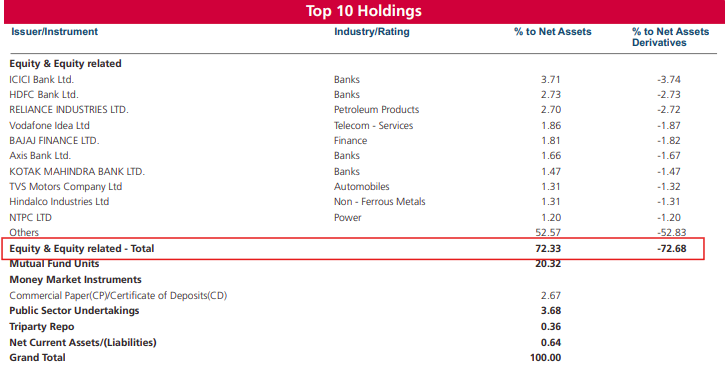
This makes the risk from equity price movements almost nil for the fund. They don’t have favourite stocks. They just want to benefit from the price difference and get out.
By the way, there are other kinds of arbitrage opportunities as well.
Say a company announces a buy back its own shares at Rs 500 per share. The stock is trading at Rs 450 in the market. The fund buys shares at Rs 450 and sells them back to the company in the buyback offer at Rs 500.
Now, not all shares may get accepted in a buyback, there’s an acceptance ratio. But even a partial acceptance means a profit on those shares. There are similar opportunities during mergers and demergers and other corporate actions too; wherever a price gap opens up, an arbitrage fund tries to capture it.
Of every Rs 100 you invest in an arbitrage fund, about Rs 65-75 goes into these kinds of trades.
The second way: returns from debt
The remaining Rs 25-35 of your Rs 100 goes into low-risk investments: liquid funds, money market funds, short-term government securities, and certificates of deposit. This money earns a steady, modest return on the side.
Here’s something worth knowing. Earlier, fund managers had more flexibility with this debt portion, some invested in instruments that carried a bit more risk for a slightly higher return.
SEBI, the regulator of capital markets in India, in Feb-Mar 2026 changed that. Now, the debt side can only invest in very low-risk debt investments as mentioned above. Existing schemes were given six months to transition and most funds are currently in transition.
The only risk here, in theory, is if the liquid or money market funds that the arbitrage fund invests in end up lending to a company that defaults. Usually, liquid and money market funds take very low risk, but it’s worth knowing all the risks nevertheless.
The tax advantage of arbitrage funds
Arbitrage funds are classified as equity for tax purposes. Even though they do not come with the same risks as equity funds, because of the equity exposure it has, they are treated as equity funds.
Let me show you what this means in real terms and how beneficial, especially, for those in the higher tax slab. .
Say two people — Priya and Rahul — both invest Rs 10 lakhs, both earn 7% in a year. That’s Rs 70,000 each.
Priya chose an arbitrage fund and held it for over a year. Her gains are taxed at 12.5%, the equity long-term capital gains rate. She pays Rs 8,750 in tax and keeps Rs 61,250.
Rahul put the same money in a liquid fund. His gains are taxed at his income slab at 30%. He pays Rs 21,000 and takes home Rs 49,000.
Same return. Practically the same risk. But Priya walks away with Rs 12,250 more.
Even if you hold for less than a year, arbitrage fund gains are taxed at 20% (equity short-term rate), still lower than the 30% slab rate on liquid funds or FDs for those falling in the higher tax bracket.
If you’re wondering how arbitrage funds fit alongside FDs and liquid funds in an emergency fund, I covered that in detail last week.
How to pick an arbitrage fund
The gap between the best and worst arbitrage fund can be as wide as 2% in a single year. When your total return is 6-7%, that’s a big chunk. Here’s a simple checklist:
Step 1: Check the track record. As the saying goes, the proof of the pudding is in the eating. Execution is everything in arbitrage — spotting opportunities, entering at the right price, managing rollovers at contract expiry. Pick funds that have been around for at least 3-5 years.
Step 2: Compare returns against the benchmark - the Nifty 50 Arbitrage Index. Most funds earn slightly less than the index because of the expense ratio, but the better ones get close or even beat it over 3 years. If a fund is consistently lagging the benchmark by a wide margin, something’s off.
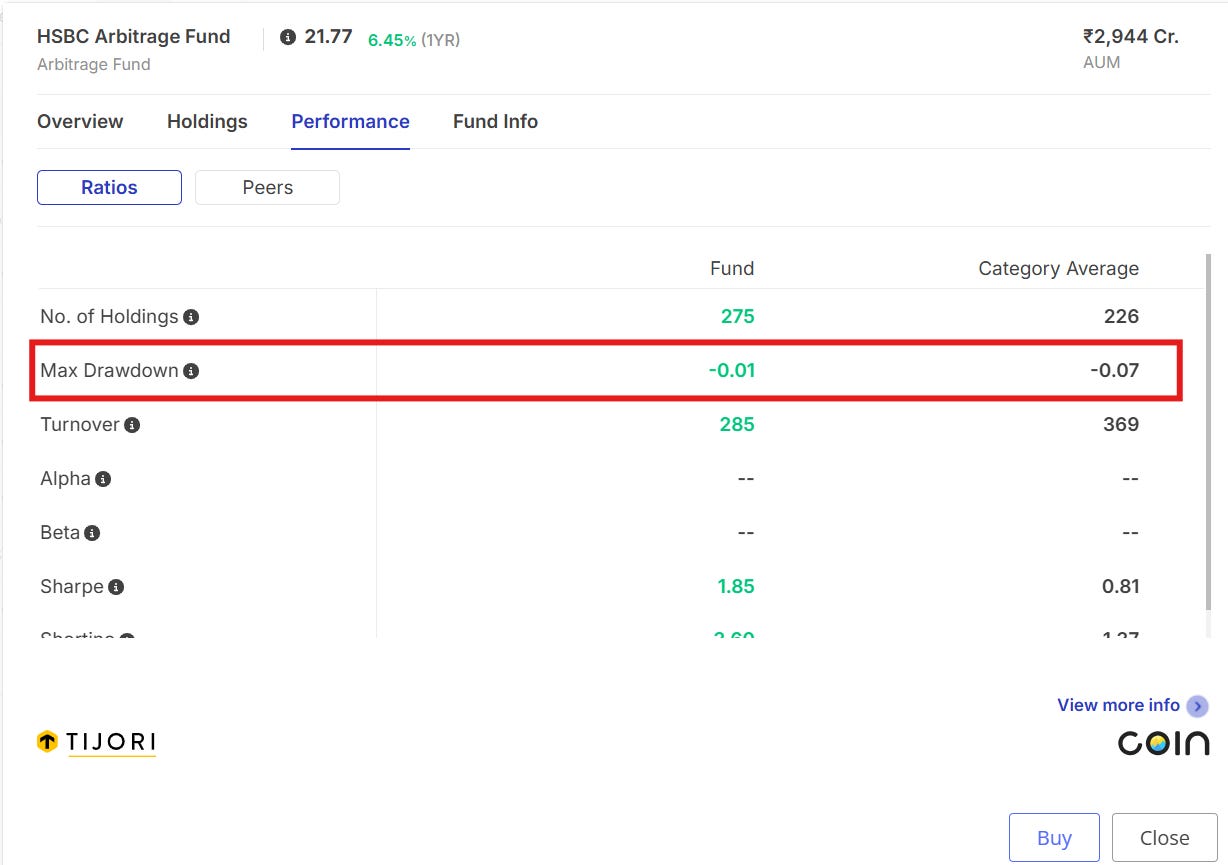
Step 3: Look at maximum drawdown. This is the worst fall a fund has seen from its peak. You’ll find it on your broker platform or Morningstar. For established arbitrage funds, this is typically -0.3% to -0.7% (2013–2026) . Anything significantly worse deserves a closer look.
Step 4: Mind the expense ratio. Direct plan costs range from 0.20% to 0.50%. Note that most apps show the TER (total expense ratio), which includes brokerage and GST of the fund and looks higher. Look at the base expense ratio (BER) instead. Know the difference here.
Step 5: Check exit load. Most arbitrage funds charge about 0.25% if you redeem within 15-30 days. This usually isn’t an issue if you invest for more than a month; but we never know when emergencies arrive and you need money from arbitrage funds, so always check.
FAQs
What kind of returns can I expect?
Arbitrage fund returns tend to move with short-term interest rates in the economy.
Why? Because buying a stock today ties up money. When interest rates are high, that money has a higher opportunity cost, so futures prices generally trade at a bigger premium to cash prices.
When the RBI had the repo rate at 4% during 2020, arbitrage funds returned about 3.5-5%. When rates climbed to 6.5% in 2024, returns jumped to 7-8%.
At current interest rates, if you hold for six months to a year, you can expect returns somewhere around 6-7% annualised returns (pre-tax), not guaranteed.
Is there a chance of losing money?
We looked at 41 arbitrage funds using daily data going back to 2013. If you held the fund for just a day, there’s a 30% chance your fund value dipped a little. Held for a week and that drops to 7%. Two weeks, just 2%. Held for 30 days or more, and there’s hardly a single instance of a negative return. Even in the worst cases, established funds have only ever fallen about 0.3-0.7% before bouncing back within a week.
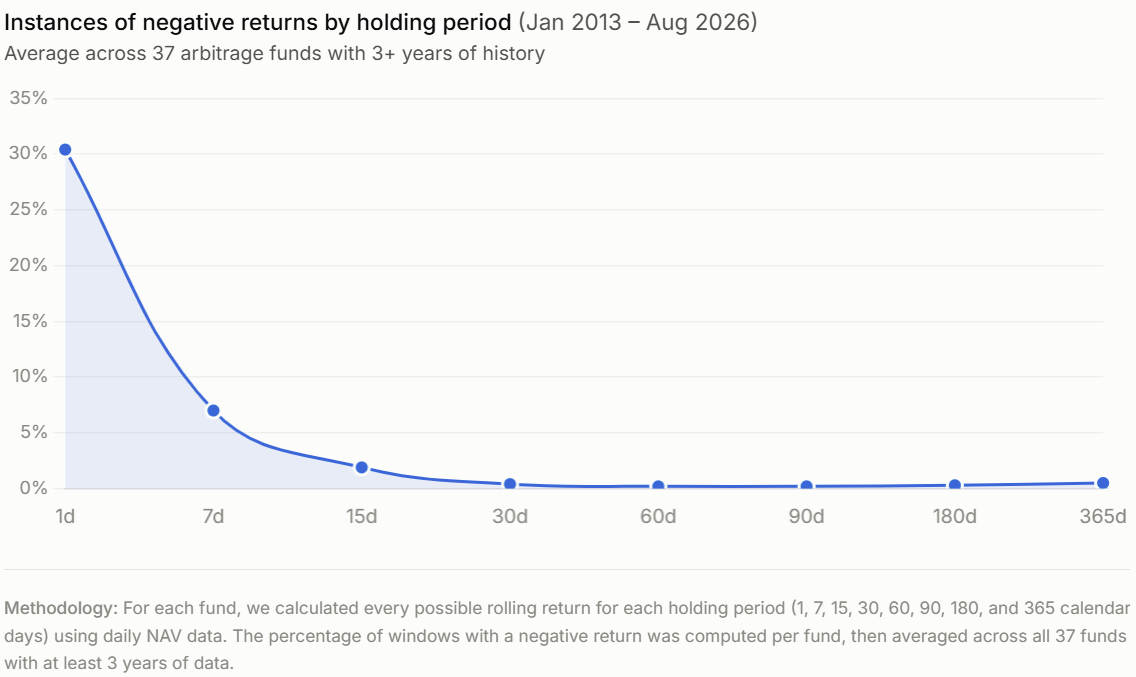
You might wonder why there are any even loss days when everything is hedged. Small daily costs like brokerage and fees, and minor mismatches between stock and futures prices within a day.
What if markets crash?
A market crash by itself doesn’t hurt an arbitrage fund, because losses on the shares are offset by gains on the short futures. That’s the whole point of the hedge. But the fund value can still dip temporarily for operational reasons.
People say derivatives are risky. Should I worry?
The core of what arbitrage funds do, buying a stock and selling its futures, is hedging, not speculation. The two positions offset each other. That said some scheme documents allow strategies like covered calls, short selling, or using derivatives for non-hedging purposes. In practice, most funds stick to the straightforward cash-futures trade, but it’s worth seeing the portfolio document (shared on AMCs’ websites every month) if this matters to you.
I’ve heard bigger funds struggle to find enough opportunities. True?
Sounds logical, but our data says otherwise. The five largest arbitrage funds actually outperformed the five smallest by 0.3-0.6% over the 1, 2, and 3-year periods we tested. That doesn’t prove size causes better returns. Larger funds also tend to be older and may have benefited from different market conditions. But it does weaken the argument that big arbitrage funds automatically run out of opportunities.
This newsletter is written by Satya Sontanam.
Do read Crude, the Rupee, and the Monsoon in our Delta newsletter.
For any feedback or topic suggestions, write to us at varsity@zerodha.com

Great explanation, I think the STT charges on future has made the transaction cost a bit higher and its impact on overall return. Government is literally charging tax 2 times on the same money. First in the form of STT and then as Income tax
Whenever I open Substack and go to Mind over Markets by Zerodha Varsity to read an article, I have never once found a single piece boring or lacking in value.
You guys are truly amazing — every article is a masterpiece in the value it brings to people like us.
Amazing work and very well written, Satya. 👌☺️